Fischerkirche
Art-Historical Gem
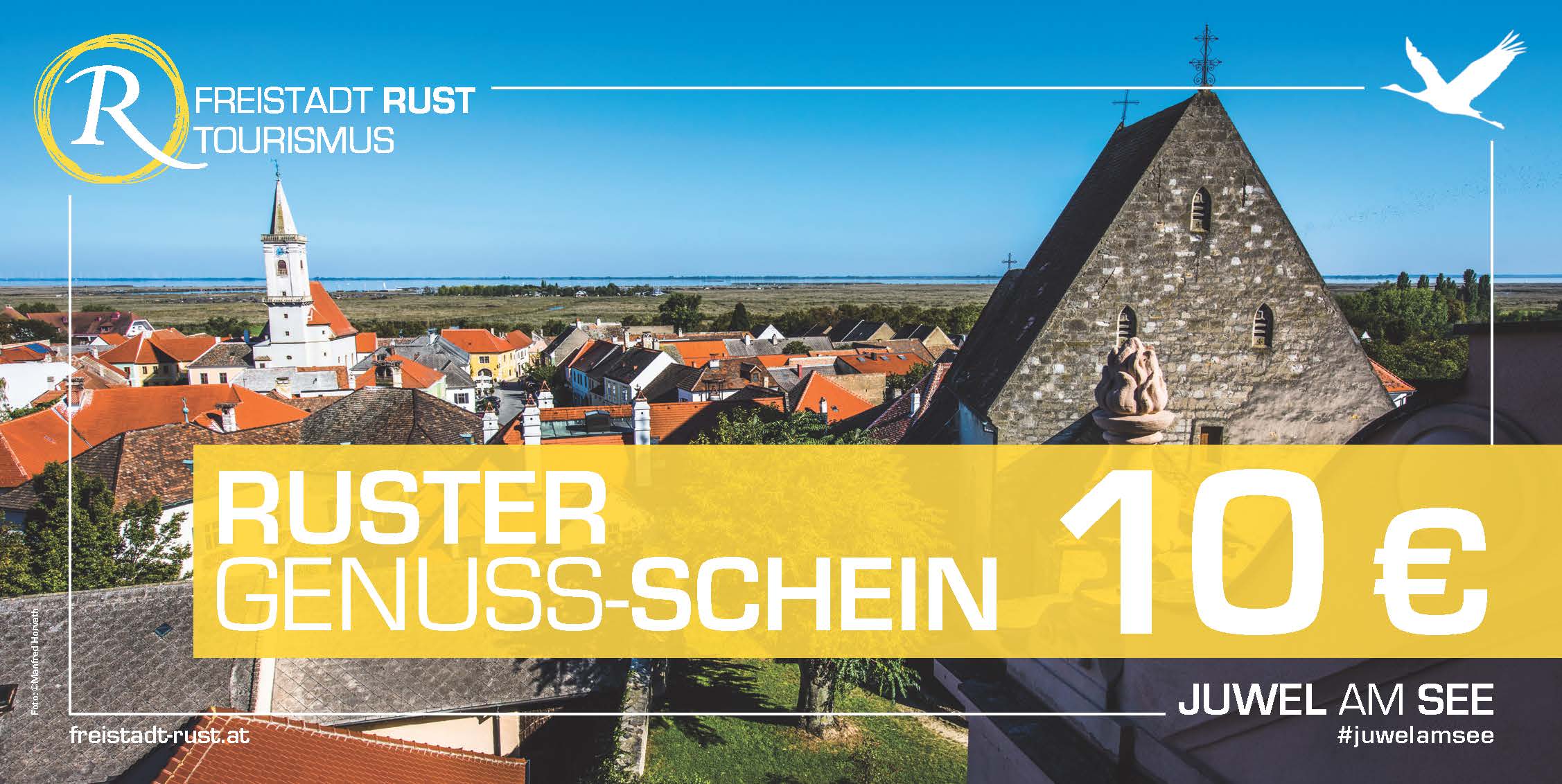
The Fischerkirche (Fishermen's Church) is the most valuable architectural structure in Rust from an art-historical and cultural-historical point of view. The history of this little church is equally as diverse and complex as the architectural periods represented within. The heart of the church is the Romanesque hall church dating back to the 11th century. The name "Fischerkirche" was first seen in the middle of the 20th century, but can be attributed to a legend.
In the 13th century, Queen Mary of Hungary, the wife of King Belas IV, is supposed to have been fleeing from the Mongolians when she was saved by fishermen from Rust after getting into terrible distress on the lake. So she donated the "Nikolausbenefizium", to which the Chapel of St. Mary, part of the Fischerkirche also belonged out of gratitude for being saved. This chapel was added to the already existing little Romanesque church facing south.
In the 14th and 15th century this Romanesque church was extended in the east by a Gothic extension with a ribbed vault, surrounded by a wall and located in front and thus integrated in the fortifications as a fortified church. It wasn't until the beginning of the 16th century that the Chapel of St. Mary and the "Pankratiuschor" (Pancreas choir chancel) were united to form one church due to the construction of the late Gothic transept.
The Baroque double onion tower, which was added to the church in 1719, collapsed in 1879 and was replaced by a simple gate. The Fischerkirche first became well-known beyond the borders of the Province of Burgenland in the 1950's, when restoration work laid open fantastically beautiful Medieval frescos in the Pancreas choir and the Capel of St. Mary. That's not all though; the Fischermen's Church has even more special features to offer:
the remains of Gothic glass paintings and Gothic cobblestones with coats of arms can be found in the Pancreas choir as well as acoustic vases - round openings in the vaulting on the buttresses - the simplest acoustic sound system of the time. This room also contains the most artistically valuable altar in the church - the Trinity Altar - alongside the High Altar. The Chapel of St. Mary not only houses a stone Pieta, but also an extremely idiosyncratic presentation of the Madonna: she is standing on a crescent moon pointing downwards over a man's head. Both sculptures date back to the 15th century. The Baroque period is also featured in the transept in the form of an Annunciation Altar donated by Ludovico de Lavende.
And the organ dating back to 1705, which is still located in the choir chancel, is the oldest (still playable) organ in the province of Burgenland.
It is most probably also due to the fact that the Fishermen's Church was actually "demoted" to an auxiliary church at such an early stage that it hasn't really been changed much or destroyed altogether.
Opening hours 2011
May 1 - September 30:
Tuesday - Saturday: 10 - 12 a.m., 2 - 4 p.m.
Sunday and Holiday: 11 - 12 a.m., 2 - 5 p.m.
October 1 - 24:
Tuesday - Saturday: 11 - 12 a.m., 2 - 3 p.m.
Sunday and Holiday: 11 - 12 a.m., 2 - 4 p.m.
Closed from October 25 to Easter!
Admission charges
Child: € 0,50
Guided Tours: € 2.00/Person (run for 10 people and over, call to make a reservation with Helga Kaiser on 0043/(0)676/9703316)
Classical Concerts 2011
Today the Fischerkirche is used almost exclusively for cultural and museum-related purposes, because there is both, a Catholic and Protestant parish church in the town. The small church has for several years now, provided the perfect setting and atmosphere for great nights of music:
11.Juni 2011
Rheintonal - Blechbläserquintett
Classic-, Film-, Musical-, und Popularmusic
9. Juli 2011
Family Singers
6. August 2011
Helmuth Ascherl
Music from the 5th century until today..
3. September 2011
Monika Stadler
Harp - Elements of the Jazz und Classic, Worl-, Folk- und Improvisationsmusik
Tickets are € 13,00, concerts start at 8.00 p.m.
For further information and advance bookings please contact: Tourismusbüro, info@rust.at, 02685/502